
AI for Nonprofits: 4 Quadrants to Cut Through the Noise
  1. Share

How Nonprofits Can Think About AI

Breaking It Down Into 4 Clear Quadrants

AI feels like it's everywhere, and nowhere, all at once. If you're leading a nonprofit, chances are you've asked yourself:
“Should we be doing something with AI?”
Or maybe:
“Is AI a threat to our work, or a tool we should embrace?”

Those are fair, and timely, questions.

But here’s the problem: AI is too broad a term. It’s like saying “technology” or “the internet”, without any context, it can mean everything and nothing at the same time.

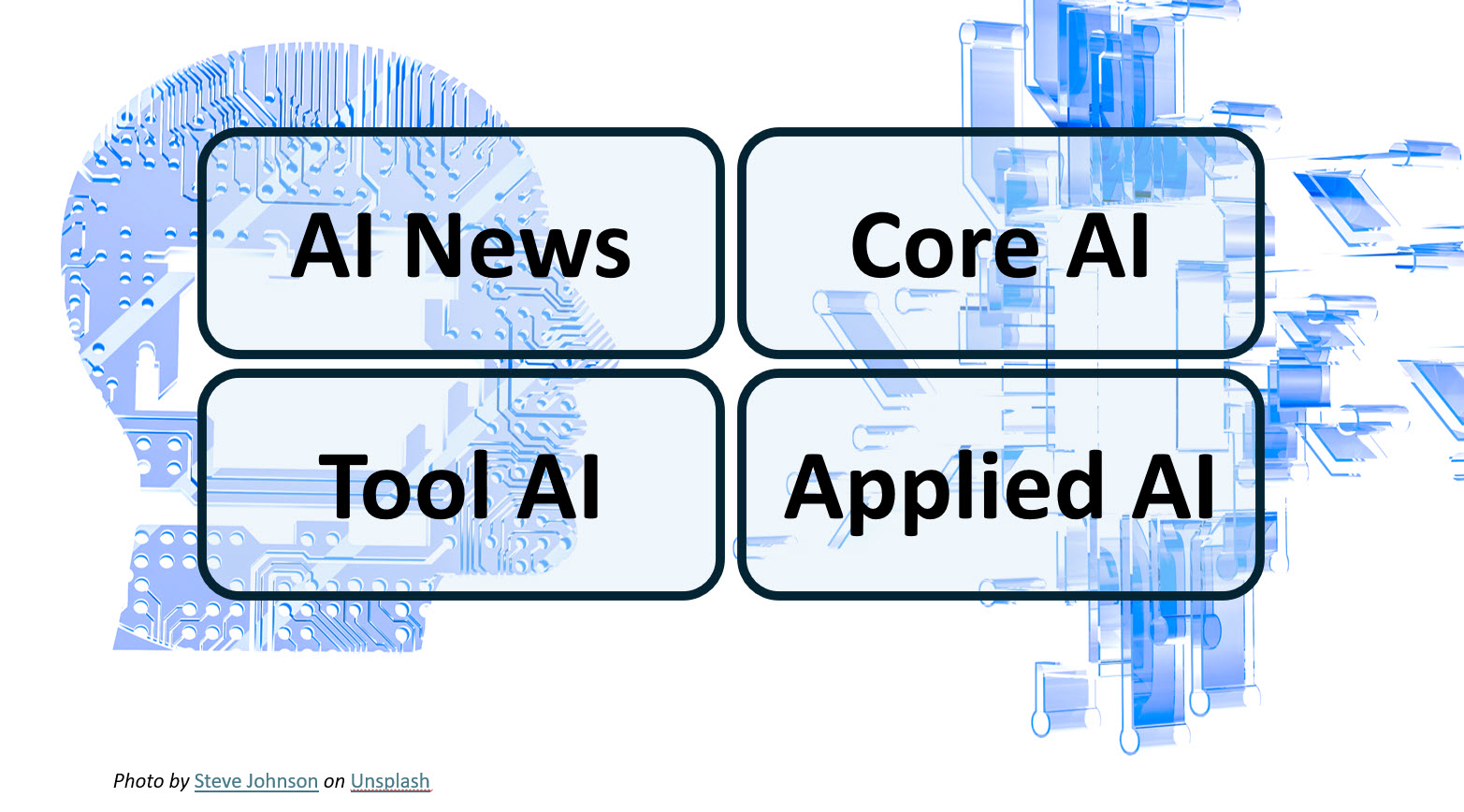
That’s why a recent framework from a conversation between ServiceReef and EC Group was so helpful. It breaks down AI into four clear quadrants, and this simple model may help your nonprofit finally wrap its head around where you are… and where you might want to go next.


🎯 The Four Quadrants of AI
1. News Cycle AI – “I keep hearing about it…”

This is where most nonprofit executives and board members start. You’re reading the headlines. You’re seeing terms flying around LinkedIn or seeing new benchmarks based on new models posted on social media. You're aware that AI is shaking up industries, but you're not quite sure how or where it applies to your mission-driven world.  

In reality, while this News Cycle AI quadrant is key for those that are living in this space, it’s mainly a philosophical conversation on an industry that is being built as it grows.  As a leader in the non-profit space, it’s important to have conversations and be aware of what is going on, but it is very difficult to base any decisions with information only in this quadrant as the news changes so quickly.  

What this looks like in your org:

  • Board members or donors ask, “Are you using AI?” or “What is your AI strategy?”
  • Typically, there is internal curiosity but no clear use cases.
  • Fear of being left behind, but no roadmap on how this could drive you forward.
     

What to do here:

  • Personally acknowledge that most questions and information is related to this space.
  • If important to your organizational strategy, then look to methods to stay on top of it.  Some examples: 
    • Assign someone to curate AI news relevant to your mission.  
    • Review monthly or quarterly as a 5 minute update.
    • Hold a “Lunch & Learn” or team roundtable to unpack key trends.
  • Watch and wait, but don’t stay here forever.


2. Tool AI – “We use AI to make our jobs easier”

Tool AI is where individuals begin to use AI-powered tools to enhance their productivity. This might be your comms director using their preferred AI model to write a donor newsletter draft, or your ops team using AI to summarize board reports.

What this looks like in your org:

  • Staff using AI for writing, editing, summarizing, image generation, or even data cleanup.
  • Tools like ChatGPT, Gemini, Notion AI, Grammarly, Midjourney, and DALL·E are in casual use.
     

What to do here:

  • Encourage responsible experimentation, maybe even create an “AI Locker” (a shared doc where staff list tools and how they’ve used them).
  • Start conversations around ethical boundaries (e.g., where AI shouldn’t be used, privacy concerns, etc.).
  • Empower your team to save time on repetitive tasks, just don’t outsource your values.
  • Leverage your prompts to look for gaps (e.g. what topics might we be missing in an upcoming meeting, etc).


3. Applied AI – “We’ve embedded AI into how we work”

This is where things get interesting… and tricky. Applied AI is not just using tools, it’s integrating AI into your workflows. It might mean using AI to screen volunteer applications, match mentors and mentees, or automatically route prayer requests to the right care team.

What this looks like in your org:

  • Custom automations using AI models (e.g., tagging photos, categorizing emails, routing requests).  Think “If A, then B” but instead of people/volunteers doing it, the agent does it for you automatically.  
  • Early experiments in building your own AI agents or using RAG (retrieval-augmented generation).
  • Strategic conversations about what data could (and should) be leveraged.
     

What to do here:

  • Identify pain points in your current workflow (e.g., repetitive review processes, follow-up tasks).
  • Work with tech partners or consultants to explore AI-augmented solutions.
  • Start small, measure impact, and scale what works.
     

⚠️ Note: This quadrant is where many nonprofits feel lost. That’s normal. Even seasoned tech companies are still figuring it out.  This area will continue to expand in the coming years, making it easier on the non-technical folks to leverage this quadrant to drive initiatives forward.


4. Core AI – “We’re building with AI from the ground up”

Core AI is the realm of model creators, those building foundational language models, fine-tuning large models on their own data, or hosting custom inference servers. This area gets a lot of the news cycle mentioned earlier, but is rarely where nonprofits need to be, unless your mission is tech-centric.

What this looks like in your org:

  • You’re fine-tuning your own LLM.
  • You’re running models locally due to privacy needs.
  • You’re building an AI-based product or service as part of your core mission (e.g., a nonprofit doing AI-powered language translation for Bible access).
     

What to do here:

  • Avoid unless it’s mission-critical or you have an R&D grant specifically for it.
  • If you must go here, build with trusted partners, hire experienced staff, and plan for sustainability.

Understanding the Quadrants
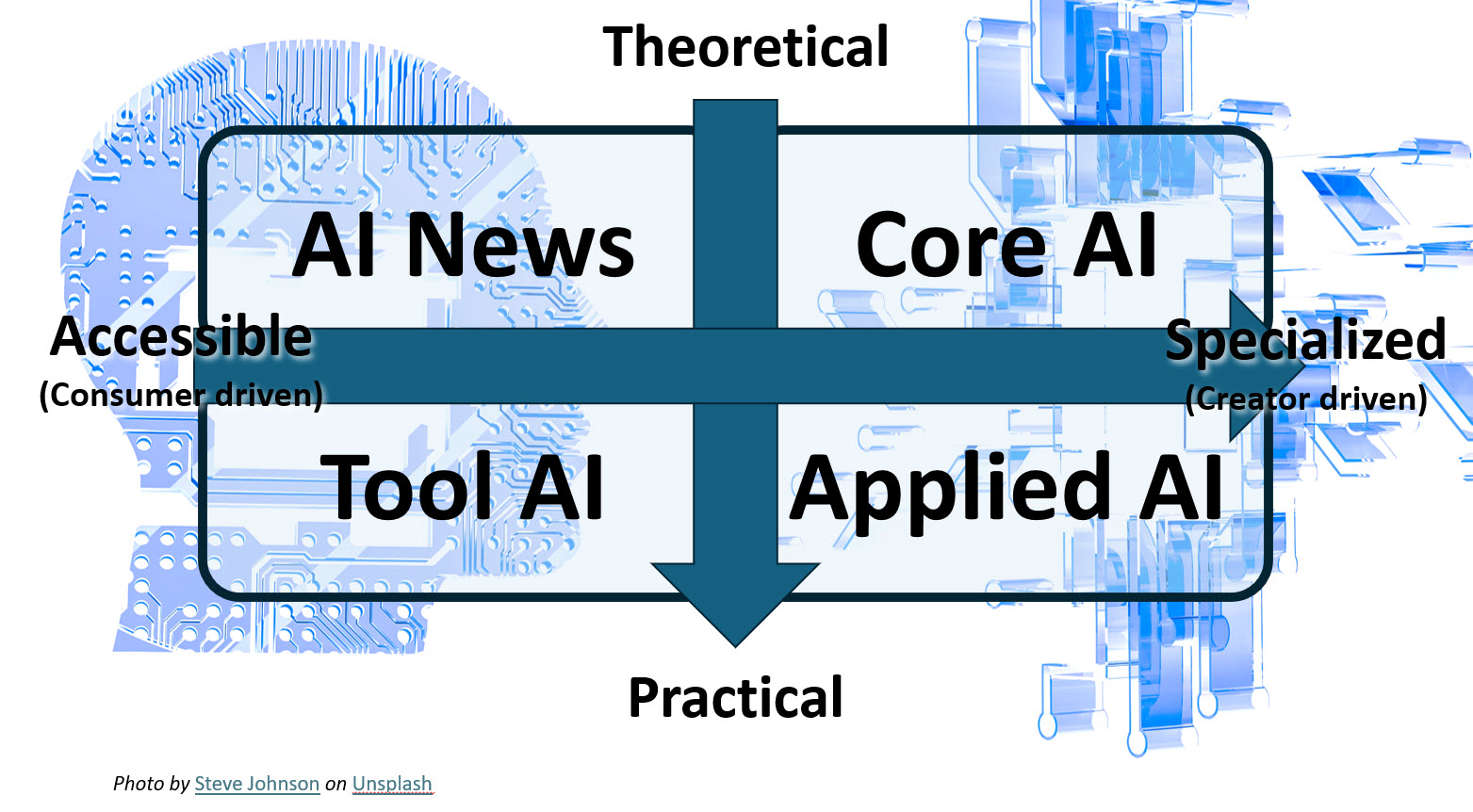
Going a bit deeper at the risk of over-simplifying the current environment: You can think of the four AI quadrants as moving along two dimensions:

  • Theoretical → Practical: On one end you have concepts and headlines (Theoretical), and on the other, real-world workflows and systems (Practical).
  • Accessible (Consumer-Driven) → Specialized (Creator-Driven): Some AI is easy to jump into with little to no expertise (Accessible), while other types require technical depth, custom development, or dedicated partners (Specialized).
     

Plotted together, these two dimensions give us the four quadrants:

  • News AI → Theoretical + Accessible
  • Tool AI → Practical + Accessible
  • Applied AI → Practical + Specialized
  • Core AI → Theoretical + Specialized
     

This framework helps nonprofits see that they don’t need to “do it all.” Most will thrive in the Accessible + Practical space, using tools and small applied workflows, without needing to dive into the complexities of Core AI.


🧭So... Where Should You Start?

Most nonprofits will look at this and think that they need to journey through these quadrants in order:

News AI → Tool AI → Applied AI → Core AI

But here’s the good news: most nonprofits will never need to get beyond Tool AI (or maybe Applied AI) and that’s perfectly okay.

Your mission isn’t to chase every shiny new AI announcement or to compete with the companies building massive language models. Your mission is to serve people, build community, and create lasting change. If AI can help you do that more effectively (by saving staff time, improving communication, or automating repetitive tasks) then it’s already serving its purpose.

Think of it this way:

  • News AI → stay informed just enough to know what’s happening. Don’t get consumed by the hype.
     
  • Core AI → almost never worth your time unless your nonprofit is uniquely positioned to build tech as part of your mission.
     

Instead, put your energy into:

  • Tool AI → empower your team to save time and sharpen their impact. Hire or encourage employees that can leverage AI for specific tasks (e.g. create video content, blogs, engage donors, etc.)
     
  • Applied AI → If you’re really leveraging tools well, then progress by identifying the 1–2 areas where automation or intelligent workflows could radically free up resources or expand reach.
     

Everything else is background noise. The real question is: how does AI help drive your mission forward today? If you stay focused on that, you’ll avoid distraction and find the practical wins that actually matter.


🕊 A Final Word for Faith-Based Nonprofits

If you’re a faith-based organization, you may be approaching AI with caution, and rightly so. AI raises ethical, theological, and relational questions that shouldn’t be ignored.

But here’s the truth: AI isn’t going away. And just like previous tech revolutions (printing press, radio, social media), the question isn’t if it will affect your work, but how you will steward it.

What if we used AI to free up time for deeper connection?
What if AI helped us reach people faster, understand needs better, and multiply our impact without burning out our teams?

These are not just tech questions. They’re leadership questions. Stewardship questions. Kingdom questions.

And they’re worth asking.


🚀 What Quadrant Are You In?

So here’s the real question: Which quadrant are you spending most of your time in right now?

  1. Are you still swimming in News AI, curious but overwhelmed?
  2. Experimenting with Tool AI in your daily work?
  3. Dabbling with Applied AI and wondering what to automate next?
  4. Or maybe just curious about the mysteries of Core AI?

Wherever you are, you’re not alone. Most nonprofits are asking the same questions and navigating this same learning curve. The best way forward isn’t to go it alone, it’s to walk together in community.

Where do you find yourself? Does any element of this resonate with your journey or experience? Share below what you’re learning.

Because AI isn’t just a technology shift; it’s a leadership and stewardship conversation. And the more we learn from each other, the better we’ll be at keeping the focus on what matters most: our mission.

Community tags

This content has 0 tags that match your profile.

Comments

To view comments or leave a comment, login or sign up.

Related Content

0
The Myth of Balance
Throughout my career, I feel that the concept of Work-Life Balance has perpetually been a struggle.  During my children’s younger years, it was nearly impossible.  It seemed as if I spent 50-60 hours at work, I should be spending at least that much time in direct contact with family or friends, or spend that much time exercising in order to “balance” all of it out. The allure of the word “balance” comes from this idea that if we can just find a way to obtain this, we can walk a narrow tightrope between expectations and find a path that somehow honors everything around us.  If we can just find balance, then we can figure out how to keep it.  While work-life is a common attempt at this, the concept permeates so many other areas of our life, even within a specific role or arena.   I used to joke with over-working employees that if balance was true, for every 60+ hour week, there would be a week in which the job would only demand 20 hours.  After all, mathematically, that is what “averaging 40-45 hours per week” would result in.  It never happened that I can recall :-) As the years have passed, I realize now that balance isn’t obtainable and is likely the wrong goal to be striving after.  I now prefer to use the concept of “tension”.   Tension in our lives There is a tension between my desire to spend time with my spouse, my family, be a good friend to others, work hard, provide value to my company and clients, exercise, etc.  All of these endeavors are good things.  However, some days, one area of my life might need, or even demand, my attention.  That creates tension on the other areas as I pull from there to provide the focus to an area of need. In my mind, the word balance conjures images of a seesaw on a playground.  One side must go down while another goes up.  While the concept of tension feels more like climbing ropes.  The tension between the climber’s weight and the belayer creates safety and allows for focus on the task at hand I have found that the concept of tension aligns more theologically as well.  There are tensions often in what God asks us to do.  Serving or giving generously, by definition, creates tension in other areas of our lives.  It becomes a question of trust: If I give in this area, can I trust you God to provide in other areas?   Tension in Scripture The Jewish scholars at the time of Jesus understood this well.  Although the law had 613 commandments spelled out in the Torah, the leaders throughout time had created additional laws to help the people keep those that were essential.  However, even within those 613 laws directly from God, there were sometimes challenges or seemingly competing priorities.   While primarily a theoretical exercise, it was essential for them to wrestle with what God asks them to do.  For example, God clearly commands that they were not to work on the Sabbath (Exodus 20:8-11).  However, if a neighbor’s donkey were to fall into a well on the Sabbath, could you help it out?  After all, Deuteronomy 22:4 commands that you help out livestock, even that of your enemies.  In this situation, what would actually constitute “work”... and if you chose to love your neighbor by helping him with his livestock in an emergency, would that actually be a better choice?  It was a situation filled with tension.  Jesus even calls them out on this in Luke 14:5.   In that time, in order to help people navigate this tension, a Rabbi would have an ordered structure to the laws of scripture that he would call his “Yoke”.  They were prioritized in the most important law, the second greatest, and so on to help make these hard decisions easier.  Those that followed that rabbi would “take on his yoke” to help them with these situations.  If you found yourself in a situation where you needed to violate a law, you could only violate it with a higher priority law. This is why Jesus was asked, “What is the most important commandment?” (Matthew 22:36-40) They were asking about his yoke, his order of how to navigate this tension between two seemingly competing priorities or commands.   Suggested practice: Each week, take five minutes to ask: Where is the tension highest in my life? What deserves my focus this week, and what can wait?   A little secret... the power of "and" In today’s world, I have found that how I handle interruptions is key to my internal struggle with tensions.  If I get aggravated by an interruption, it’s likely an insight into how I’m doing internally or even how I’m currently managing my tensions. As I have wrestled with this over the years, I realize that it comes from this western perspective that I can only be doing A OR B activities.  There is some truth to that; by pulling my attention from A to give it to B, I am no longer focussed in that area.  However, this is not always true.  There are elements in which I can combine activities to achieve two elements at once.  Quick examples might include:  Walking with a spouse or friend, which provides both exercise AND relational connection Making dinner while listening to music/podcast; performing a task AND refueling yourself Taking someone to practice and bringing a book or taking a walk while waiting; allowing you to pour into yourself AND get some time with your child If you can find ways in which you can accomplish two key functions at once, you can more easily live within the tensions that life provides.   Living within health tension I have tried, not entirely successfully, to try and view situations as a chance to be intentional with my “and”.  Driving to yet another soccer practice can instead by viewed as a chance to get an uninterrupted 10-20 minutes in the car with one my kids, allowing myself to be intentional for that ride.  It’s not “just” an interruption to the day.   However, having the understanding of “tensions” instead of just striving for balance.  And then layering on the ability to view life and interruptions as a chance to navigate and find an “and” in the situation allows me to better live within the world and demands of every week.   Some other ways that help are: Naming the tension rather than fighting it. Setting “seasonal” priorities instead of daily ones. Inviting accountability through a spouse, mentor, or friend.   Wrapping Up Jesus’ yoke he presented as being easy and his burden is light (Matthew 11:28-30).  Jesus wasn’t removing the tension but helping us live it out in peace by fulfilling all of the law into two areas: Love God and Love Others.  As you reflect this week: Where in your life are you chasing balance instead of embracing tension? What’s one area this week where you can practice the power of ‘and’? What is one thing you can release or let go of in order to focus on where God is calling you? I hope you find blessing in this perspective as well.  Let me know what you think and where this provides benefit to you below. 
0
11 Creative Ways Non-Profits Can Engage Donors at Year's End
As the year draws to a close, non-profits have a unique opportunity to engage their donor base and maximize contributions. Here are eleven innovative ideas that can help make your year-end fundraising efforts stand out: 1. Virtual Reality or 360-degree Experiences Enhance donor understanding of your impact with virtual reality (VR) or a 360-degree experience that shows the real-world impact of their contributions. For instance, a conservation organization might offer a VR tour of a forest they helped preserve, providing an immersive, firsthand view of where donor funds are going.  Or an international organization can provide drone footage or a walk-through of an area which they impacted this last year.  Don’t have a VR experience available?  You can always leverage videos from the field to help provide this experience.   2. Interactive Online Dashboard or Impact Map Create a dynamic, interactive dashboard that updates in real-time to show the impact of donations. This can visually represent the number of people helped, wells dug, or kids cared for, making the donor's impact tangible and immediate.  If you can tie this to a map of impact for your organization, even better.  For those already on ServiceReef, this is built in for you and you can read more about building your interactive map points and stories here.   3. End-of-Year Giving Advent Calendar Engage donors with a digital or physical advent calendar. Each day could reveal a different impact story, a personal thank you video, or a small token of appreciation, keeping donors connected and engaged throughout the holiday season.   4. Donor Appreciation Video Montage Compile heartfelt thank-you videos from beneficiaries or staff, showing the faces and stories behind the contributions. Sharing these personal messages can forge stronger connections between your donors and your cause.   5. Holiday-Themed Competitions Host creative competitions like holiday card designs or themed photo submissions. Offer prizes and feature winners in your communications to foster a community spirit and involve your donors in a fun, meaningful way.   6. Time Capsule Project Invite donors to contribute to a time capsule with messages or items reflecting the year’s achievements. Plan to open it at a significant future event, offering a unique historical snapshot of your organization's impact and donor contributions.   7. Customized Gift-Giving Options Allow donors to give a donation as a gift. Provide customizable gift certificates explaining the donation's impact, ideal for donors looking for meaningful holiday gift options.  If you want to customize gifts to donors this year, provide them with a page where they can select from 3-5 options as a thank you from your organization, thereby allowing donors to select something that would matter to them or provide that token of appreciation as a gift to others.   8. Donor Spotlights Show appreciation by featuring donor stories in your newsletters or on social media. Highlighting individual contributions can inspire others and demonstrate the diverse support network behind your mission.   9. Flash Fundraising Challenges Organize 24-hour fundraising challenges with specific goals. Encourage engagement and sharing on social media to create a buzz and drive donations.   10. Recipe or Craft Book Compile a downloadable book of recipes or crafts related to your mission, contributed by staff, beneficiaries, and donors. Offer it as a special gift to donors who contribute a designated amount.   11. Legacy or Memorial Gifts Promote a program where donors can contribute in memory of a loved one. These gifts create a lasting legacy and are especially meaningful during the reflective holiday season.   You all are even more creative than we are… What ideas are you thinking about this year?  What ideas have resonated well with your support base in the past? Our hope is that by implementing 1 or 2 of these creative strategies, you can not only boost end of year fundraising efforts that allows your mission to go farther in the coming year… but also deepen your relationships with donors, creating a foundation for sustained support and engagement.  Blessings on you this season!